Showing posts with label Home. Show all posts

What I Use Now: Non-toxic Household Cleaners & Personal Products


Knowing my propensity to over-research consumer products, sometimes a friend or family member will call me to ask my advice about a particular non-toxic cleaner, lawn treatment, or mattress. But recently my neighbor decided to completely overhaul all her household cleaners and personal products and asked me to share with her what I use. And as I pulled up some old blog posts to share with her on these topics, I noticed that while much of the information and reasoning behind my choices was still up-to-date, many of the products were not. Some products have been discontinued. Some have been replaced with less toxic or more effective ones.

So I decided to make an exhaustive online list of our household cleaners and personal products to share with her and others that I intend to continually update. This list shares what I am actually using now in my own home and with my own family, 10+ years into the eco-friendly journey. The page also includes links to posts on the category (laundry, kitchen, teeth, hair, etc.) and where to find more information about your own cleaners or my cleaners

I would also like to note that there are a lot of great green cleaners out there now (or you could make your own non-toxic cleaners, although I never have), but for certain categories, it took a lot of trial-and-error to find something that worked for us: in particular, dishwasher detergent and hair products (our family has thick curly hair). I hope my painful experiences will spare you some.


You will find the continually updated list here:
What I Use Now: Eco-friendly Household Cleaners & Personal Products


Did I leave something off that you'd like to see? Let me know in the comments below. 


You May Also Like

Would you like more ideas and tips about Going Green Gradually? Sign up for my free email subscription to get each of my posts delivered to your inbox (I usually post one or two times a week). You can also follow me on Facebook, Google Plus, Pinterest, Twitter, or with your favorite RSS Reader. I hope to see you again soon!

Disclosure: This post may contain affiliate links. Your purchase via these links helps support my blog. Thank you for your support. Read my full disclosure policy here.

Is Your Home Shoeless? 3 Critical Reasons to Leave Shoes at the Door


As we enter the winter months and the holidays, keeping shoes out of your home can become a little more challenging. But the benefits are worth it! Removing your shoes (and encouraging your guests to do likewise) reduces the amount of toxic pollutants in your home, decreases the time and money you spend on cleaning, and promotes the development of healthier stronger feet.


7 Simple Ways to Reduce Your Family's Exposure to Toxic Flame Retardants

© Depositphotos.com/alenkasm

Flame retardant chemicals are Persistent Organic Pollutants, meaning that they are toxic, persistent, bioaccumulative, and capable of long-range transport from their original source (flame retardants have been found in high concentrations in polar bears and the Inuit people). They have been linked to "cancer, neurological deficits, developmental problems and impaired fertility" (source). Fetuses and young children are particularly susceptible to their effects. They are also nearly impossible to avoid.

Avoiding Toxins in the Backyard


School's out and that means that my kids are spending a lot more time in our backyard. I am a big fan of outdoor play for kids and adults. Unfortunately, there are several ways that we adults inadvertently make our backyards less of an ideal play location for our children by introducing toxic chemicals. Here are some ways you can make sure that your backyard stays safe and eco-friendly this summer.


Pesticide-free Bug Control


In my area, hot weather means bugs. They sneak in your home looking for moisture, shelter from the heat, and, of course, some morsels to eat. Just the other day the Pesticide Salesman stopped by my door to let me know that two of my neighbors were spraying for ants and spiders and did I want to sign up too (at a discount, of course!) so that they didn't all run into my house when he, "flushed them out" of the neighbors' yards and crawl spaces. Turns out I'm much more worried about the neurotoxins in pesticides than ants and spiders, so I turned him down. But I'm not a huge fan of bugs in my house. I've had ant, fruit fly, and cockroach invasions and lived to tell the tale, without the use of toxic pesticides! This is my tried-and-true ant bait/ trap (keep away from little hands and animals), and a non-toxic spray we use around the perimeter of our house to discourage cockroaches. House spiders are generally welcome at my home! Check out Beyond Pesticides for safe alternatives to toxic pest control.

Two Things to Do Before You Spring Clean


Get Rid of Stuff


Before spring cleaning is the perfect time to ruthlessly eliminate clutter, since deep cleaning often involves moving lots of stuff around. And by clutter I mean stuff you own that you don't use, don't need, and maybe don't even want. I've seen a lot of spring cleaning checklists that include tossing clutter while cleaning out this or that. This would never work for me. If I were taking everything out of a drawer to wipe it out, and I stopped to consider whether I should keep or get rid of each item, I would never finish cleaning anything. Take the week before beginning spring cleaning to purge the contents of one room each day and get rid of as much as you can before you ever spray a cleaner or wipe down a surface.


Use Bar Soap {Easy Eco-tip Tuesday}


Today's Easy Eco-tip: 


Use bar soap instead of liquid soap.

Give bars a chance.


For several years now, body wash has outstripped bar soap in sales. I think it's safe to say most Americans are using liquid hand soap rather than bar soap as well. But before 1980, liquid soaps were virtually non-existent. One of the things I love about our 1960s bathrooms is that the sinks have little indentations on each side of the faucet for bar soap. Imagine that! Instead of a built in stainless-steel soap dispenser, the latest and greatest in 1960 was a built-in place to store your bar soap. There are many reasons to give good old-fashioned bar soap a second look.

Compared to liquid soaps and body washes, bar soaps:

Shop Green on Black Friday


I don't have to take any pledges to stay home from shopping Thanksgiving evening. Or even on Black Friday. Because I dislike shopping and dislike crowds, so there you go. No Black Friday shopping for me.

Except online. Black Friday is a great time to purchase some of those green products that have been sitting on your wish list for a while.


Six Simple Steps to a Paperless Kitchen


1. Switch to cloth napkins.

Not ready to commit to a paperless kitchen? Still in love with paper towels? Just try switching to cloth napkins. You'll feel like you are eating in a fancy high-end restaurant every night! We use a mish-mash of cloth napkins at my house. I like cotton napkins that are somewhat absorbent best, because then they can soak up a spill in a pinch. We use our cloth napkins for a full day (sometimes longer) before washing. We just leave them on the table between meals. You can get different napkin rings if you want to make sure each family member reuses the same napkin.

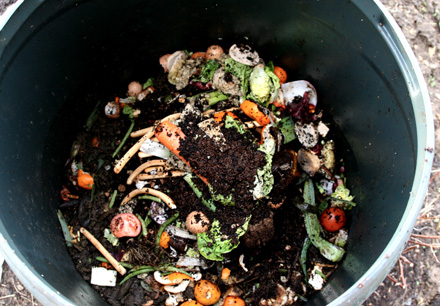
Question: How Do You Compost? (Please Comment!)


Dear Readers,

Help me out. I really want to compost. I feel guilt every time I toss watermelon rinds and carrot peelings in the trash. But I'm having trouble jumping in and trying it. Here are my issues:
  • There are multiple methods. Which one is the best for me? Note that I have actually ruled out worms because a couple of my friends tried that method and it seemed like a lot of work.
  • If it takes too much time, I will fail. I know, because I watched two tomato plants die over the summer simply because I didn't water them. (In case you are concerned, my husband is in charge of watering our new tree.)
  • I have a toddler. A crazy, gets-into-everything, I-cannot-control-her toddler. I need to be able to let her roam somewhat unsupervised in the backyard or I will lose my mind. We are also hoping to get a dog. I cannot have an amorphous pile of compost that my toddler or future dog will get into.
  • I'm scared of attracting vermin. I've had ants, cockroaches, fruit flies, and rats. There are also plenty of stray cats and dogs in my neighborhood that I would like to stay off my property.
  • I am completely willing to drop $100 to $200 on a compost bin if it will solve all my problems and make all my composting dreams come true. But I'm scared I'll buy a bin, and it won't work all that well, or won't make composting easy-peasy enough, and then I won't use it, and then I'll have a big hunk of plastic in my backyard and a lot of eco-guilt.

Click here to continue reading (and to comment!) at The Green Phone Booth.

If you are a composter, I want to hear from you! Please click over and share your wisdom.

Use Eco-friendly and PVC-free Yoga Mats to Avoid Phthalates and Other Toxic Chemicals


Once I began exercising again after my third child was born, I decided it was time to retire my decade-old yoga mat and invest in a new one. My old yoga mat was very thin and not very high quality (it came free with a yoga DVD), but still usable. However, after years and years of using it, it dawned on me that it was almost certainly made of vinyl (PVC).

PVC is arguably the most toxic plastic. It's made with toxic chlorine which results in toxic dioxin being released into the environment. PVC products are also made using toxic additives such as lead and endocrine-distrupting phthalates, additives which readily migrate and off-gas during the use of PVC products. I especially wasn't comfortable with exposure to phthalates, which are added to PVC to make it soft and flexible (like a yoga mat), and which readily migrate to the surface of PVC products in which they are found. Phthalates also readily pass from mother to fetus through the placenta and are also found in breastmilk.

Phthalates are endocrine disruptors and have been linked to:
  • lower testosterone levels
  • decreased sperm counts
  • poor sperm quality
  • malformations of the male reproductive tract and testicular cancer
  • obesity
  • reduced female fertility
  • preterm birth and low birthweight
  • a worsening of allergy and asthma symptoms
  • behavior changes

Natural (PVC-free) Yoga Mats


Ten years ago, I'm guessing it was pretty difficult to find a PVC-free yoga mat. But now, thankfully, there are many PVC-free options. I wanted a natural rubber mat, and also a thicker one that would give me some decent cushion on top of my hardwood floor. I ended up purchasing the Gaiam Sol Power-Grip Yoga Mat made of natural rubber (note: I remember that it smelled strongly of rubber initially). It is pretty thick (4 mm) and has a nice grip to it too. I use my mat for beginning yoga but also for general exercise (while barefoot on hardwood) that includes pilates, weights, cardio, and stretching. I do not get super sweaty when I workout and am not terribly concerned about slippage. If you are a serious yogi, see the reviews below by yoga experts.

Some other natural (PVC-free) yoga mats include:


TPE and PER Plastic Yoga Mats


There are also less expensive synthetic yoga mats made from Thermoplastic Elastomer (TPE) and Polymer Environmental Resin (PER). TPE is a synthetic rubber that is touted as a healthy alternative to PVC. According to Thinksport, TPE is "free of BPA, PVC, Lead, Phthalates, Dioxins, and biologically toxic chemicals." What exactly TPE is I couldn't tell you. But I feel confident stating that it is far better than traditional PVC.

Yoga Mats Made from Thermoplastic Elastomer (TPE) 


Probably the least expensive alternative to traditional PVC is Polymer Environmental Resin (PER), which is touted as a less-toxic form of PVC. According to one manufacturer, which describes PER as "clean PVC," PER is free of "phthalates, dioxins and furans, phenal, or heavy metals and has a ecologically safer method of production which is better for the workers and the environment."

Yoga mats made from Polymer Environmental Resin (PER)


For my daughter, who often likes to "exercise" with me, I got a smaller mat so it wouldn't take up as much room. I purchased the Namaste Kid's Eco-friendly Kids Yoga Mat (made of PER). It measures 24" by 48" and is much thinner than mine, but suitable for my toddler, 4yo or even 6yo. It's main purpose is really to keep them off my mat and out of my way. I actually didn't realize PER is a form of PVC when I bought it. I couldn't find a small-sized rubber yoga mat. In retrospect, I would have preferred a TPE mat such as the Little Yoga Mat for my kids, but I don't feel strongly enough about it to stop using the PER mat.

Looking for additional PVC-free products? Check out these posts that describe and review PVC-free:
Stay tuned for additional posts about PVC-free alternatives to traditionally vinyl products.


Additional Eco-friendly Yoga Mat Reviews for Serious Yogis


How do you avoid PVC?


Would you like more ideas and tips about Going Green Gradually? Sign up for my free email subscription to get each of my posts delivered to your inbox (I usually post one or two times a week). You can also follow me on FacebookGoogle PlusPinterestTwitter, or with your favorite RSS Reader. I hope to see you again soon!

Disclosure: This post may contain affiliate links. Your purchase via these links helps support my blog. Thank you for your support. Read my full disclosure policy here.

Easy Eco-tip Tuesday: Unjunk Your Mail Box


We purchased a home a little over a year ago. And with that home I inherited yet another batch of junk mail. Some days the mail box was jammed so full with the grocery circular as well as magazines and catalogs from the former resident that I could barely get my mail out. Luckily for me, I cleverly documented the unjunking process for myself on this blog about two years ago.

If your junk mail is clogging up your mail box and hogging your recycling bin, follow these four simple and free steps to an unjunked mail box. You'll be happy you did!

How to Unjunk Your Mail Box

Step 1: Save Your Junk
Series Reprise and Final Tips

Related Posts

Easy Eco-tip Tuesday: Clean with Vinegar
Easy Eco-tip Tuesday: Shop at Your Local Farmers Market
Easy Eco-tip Tuesday: Wait One Week to Make a Purchase


Are you interested in Going Green Gradually? Sign up for my free email subscription to get each of my posts delivered to your inbox (I usually post two or three times a week). You can also follow me on FacebookPinterestTwitter, or with your favorite RSS Reader. I hope to see you again soon!

Help Protect the Endangered City Forest: Plant a Tree!

Getting ready to plant a fruitless olive tree so I don't have to stare
at my backyard neighbor's second-floor balcony all day.

Several months ago I walked into my local library and saw some young people sitting at a table with a giant "Free Trees" sign. We had recently purchased a home and for the first time in many years were in a position to change our own landscaping. So I wandered over with my three little kids in tow and started asking questions. The table was set up by Our City Forest, an organization dedicated to increasing the number of trees in my metropolitan area.

Our Endangered City Forest


Through this organization, I learned some disheartening facts about trees in cities:
  • Large American cities are losing trees four times as fast as they can be replanted.
  • Between 90 million and 100 million trees must be planted each year over the next decade to develop and maintain America’s urban forest.
  • The average life of a street tree in America is as little as 8 years, compared with 40 years or more for trees removed from urban stresses.
  • The number of trees per person in the U.S. has declined by 13% during the past 9 years.
  • One million acres of forest are lost to American city growth each year.
  • California's urban forests are becoming shorter because cities are planting more short-statured trees; as the urban forest is downsized, many of the ecological benefits that large trees provide will be diminished or lost. 

The Benefits of Trees


Buying an Eco-friendly Outdoor Wood Play Structure: Why I Chose CedarWorks


After our used pressure-treated wood play structure debacle, I began researching options for new wood play structures. I seriously considered six different manufacturers. I searched online for reviews and discussions in parenting forums, drove considerable distances to look at play structures in person, asked salespersons and customer service representatives numerous questions over the phone, and crunched a lot of numbers. Although it was a bit of our stretch for our budget, in the end we chose to purchase a CedarWorks Frolic play set for the reasons explained below.

Why I Chose a CedarWorks Frolic Play Structure


Do You Line Dry Your Laundry?


Line drying: so simple, so frugal, so green.

And yet, kind of a pain. In green blogger circles, you sometimes here this confession: I no longer line dry. We all have a finite amount of time in the day, and it could definitely be argued that the time and effort you spend line drying might be better spent participating in writing letters or making phone calls to your representatives regarding your concerns about climate change.

I have many frugal friends who rarely touch a dryer. My friend Heidi even considers hanging her laundry somewhat therapeutic or meditative or something. Even though I've fallen off the line drying wagon I still always line dry certain types of loads:

Eco-novice's Advice and Rules for a Green Remodel


About a year ago, my husband and I purchased a home that needed some remodeling. I'm no green building expert. I'm just an eco-novice who needed to make some renovations to a home. But I'll share with you what I learned during my crash course in eco-remodeling. If I could give you one piece of advice, should you need to make renovations, it would be to hire a green contractor. Make sure you get a good one of course and still ask a whole lot of questions, but by doing this one thing you will probably save yourself countless hours of research and a lot of anguish and even the regret that comes with 20-20 hindsight.

I, however, couldn't afford a contractor, much less a green contractor for most of our renovations. The next best thing to using a green contractor, I believe, is to find a green building supply store, and then pick the employees' brains (and buy lots of materials from them too). Late in the game I found an incredibly helpful person at a green buildings supply store near me when I was shopping for paint. How I wish I had met her sooner (and had purchased more things from her)! During our renovations process, I also found information by searching the web and checking out books about green building from the library.


Eco-friendly and Budget-friendly Arts & Crafts Supplies


Kids love to cut, glue, draw and make things. Unfortunately, the less expensive conventional arts and crafts products often contain ingredients that are unsafe for small children. For example, finger paints may contain toxic heavy metals and developmental toxicants. Not very kid-friendly!

Make It Yourself


As is often the case, if you are on a limited budget but want to avoid toxic ingredients, your best option is to make it yourself. Luckily, many of kids' favorite materials are super easy and inexpensive to make. Here are a few recipes to get you started (click on link to source for additional instructions and photos):

Choosing Arts & Crafts Materials that Are Safe for Kids


Kids love to cut, glue, draw and make things. Unfortunately, the less expensive conventional arts and crafts products often contain ingredients that are unsafe for small children. For example, finger paints may contain toxic heavy metals and developmental toxicants. Not very kid-friendly!


What to Look for


Luckily, there are lots of eco-friendly and non-toxic arts and crafts products on the market now. When shopping for eco-friendly arts and crafts materials, I look for (click on links for examples): 

An easy way to find such products is to shop with green businesses such as MightyNest or Abe's Market, which both have a great selection of arts and crafts products. Another easy option is to subscribe Green Kid Crafts, an earth-friendly craft project subscription service (see my review here). You can also try making certain arts & crafting materials yourself from scratch.


What to Avoid


Pesticides in Pressure-treated Wood Pose Health Risks


Let me tell you a really sad story.


Several months ago I started trolling Craig's List for a used wood play structure. My friend had found a pretty nice one for free and I was a little jealous. (Note: my friend did have to drive an hour to pick it up and then invested about a hundred dollars replacing some beams and other parts -- but still, what a bargain!) Also, we had recently purchased a home that was, tragically, not walking distance to a single park. I went to look at a few structures and was unimpressed, especially given the asking price. Then I found one really close by for a great price. The whole family swung by to see it on the way to the farmer's market and we immediately gave the seller a down payment. It seemed perfect: 4 swings (enough for my 3 children plus a friend), monkey bars, a fast slide, and an enclosed fort under the tower.

Soon after my husband rented a truck and enlisted some friends to help him move it to our backyard. The seller was nice enough to do much of the disassembling. Then my husband spent a couple of weekends reassembling it. My kids were thrilled. All seemed well with the world. Until I happened upon some information about pressure-treated wood and arsenic.

And suddenly I realized that the play structure my husband had worked so hard to assemble in my backyard might not be the all-natural wholesome goodness (what's more natural than wood?) that I had taken it for, but might in fact be wood treated with chemical preservatives (a.k.a., pesticides).


Easy Homemade Starch for Ironing (and DIY Alternative to Dry Cleaning)


Do you take clothes to the cleaners? My husband used to take his dress shirts and pants to a dry cleaner. Once I entered the green path, I learned that there are many reasons to avoid conventional dry cleaners:

  • the chemicals involved  (PERC) are pretty nasty
  • dry cleaned clothing off-gasses some of those nasty chemicals into the air you breathe
  • dry cleaning generates an enormous amount of waste from single-use plastic bags and hangers (although the hangers at least can usually be returned and reused)

As is often the case, first I found a greener alternative, and then figured out a DIY solution because the greener alternative was so darn expensive. In addition, it's not entirely clear that all of the "greener" dry cleaners are actually all that eco-friendly.

CONNECT WITH ME


© 2008-2020 Eco-novice: Going Green Gradually All Rights Reserved

Copyright © Eco-novice | Powered by Blogger

Design by Anders Noren | Blogger Theme by NewBloggerThemes.com