Easy Eco-tip Tuesday: Shop at Your Local Farmers Market

Find your local farmers market here.

Today's Easy Eco-tip:

Shop locally and in season without even trying by shopping at your local farmers market.

Consider bringing a neighbor with you or just telling a friend about your incredible purchases. You won't have to deliberate about whether you should buy those organic apples grown in Chile because they simply aren't available. Also not available: sugar cereals and packaged snacks with fifty ingredients. When you are shopping at the farmers market, anything your children beg you to buy, you'll probably feel pretty good about buying.

In addition to taking all the calculation and mental effort out of shopping locally and seasonally, the farmers market makes it super easy to reduce the amount of food you buy in disposable plastic packaging. Huge bonus: no little stickers on your produce!

If you're still buying most of your produce at the grocery store, I strongly suggest you find your local market and check it out, especially now while it's summer. Right now our local markets are bursting with stone fruit and berries and tomatoes. Last week I bought my first grapes of the season. Yum!

If you are a farmers market veteran, consider spreading the word. I always like to tell acquaintances new to our area about our incredible farmers markets. Many folks don't even know that they exist. I like to tell people how much I like meeting the farmers, how much my kids enjoy the samples, how fresh and tasty everything is. Even folks who don't consider themselves "greenies" can appreciate the benefits of the farmers market.


Related Posts
Getting the Most Out of Your Farmers Market
My Love Affair with the Farmers' Market
How I Shop for Food
Everything I Know About the Farmers Market


Do you shop regularly at a farmers market? Why or why not?

Easy Homemade Starch for Ironing (and DIY Alternative to Dry Cleaning)


Do you take clothes to the cleaners? My husband used to take his dress shirts and pants to a dry cleaner. Once I entered the green path, I learned that there are many reasons to avoid conventional dry cleaners:

  • the chemicals involved  (PERC) are pretty nasty
  • dry cleaned clothing off-gasses some of those nasty chemicals into the air you breathe
  • dry cleaning generates an enormous amount of waste from single-use plastic bags and hangers (although the hangers at least can usually be returned and reused)

As is often the case, first I found a greener alternative, and then figured out a DIY solution because the greener alternative was so darn expensive. In addition, it's not entirely clear that all of the "greener" dry cleaners are actually all that eco-friendly.

The Poop Report: Diapering and Pottying at 18 Months


For links to every post I've ever written about early potty training, visit my Early Potty Training page.

18-month Potty Update


Right around when my daughter hit 17 months, I realized that she had been dry day and night for 4 days straight save one accident. I felt like we had turned a corner.

Luckily, I was also smart enough to realize that this was probably not the end of my third potty training adventure. The truth is, my toddler definitely knows how to both use the potty and how to hold it. But often she has other priorities.  So here's how things have been since that blissful 4-day stretch.

My 18-month-old is consistently dry at night. 
I'd say she wakes up wet maybe once every two weeks. That's nursing to sleep, sleeping 11 or more hours, nursing several times at night (sometimes awake and crying several times at night because she's sick or because molars are coming in), and then waiting 10 or more minutes to use the potty after waking up, and still staying dry.


Easy Eco-tip Tuesday: Wait One Week to Make a Purchase


Today's Easy Eco-tip: 

Next time you think of an item you need or would like to purchase, write it down on your "To Buy" list, and then wait at least one week to buy it. Of course I'm not referring to toilet paper or eggs here. I'm talking about clothing, toys, books, tools, small appliances, that kind of thing. If you wait one week, you might discover that:

1. You don't really need or want the item.
Because I consider shopping (even online shopping) with children to be mild torture, things often sit on my "to buy" list for weeks or months on end before I go to the store, by which time I often discover that the item that I once thought was essential is actually entirely unnecessary. It is not unusual to decide that I don't really need or want half of the items on my shopping list.

2. You already own something which will serve the same purpose.
For a long time I had cloth napkins on my to buy list. We had a few, but we really needed more, and I kept meaning to buy some. Then one day while cleaning out my garage, I found a bin that contained never used linens (wedding presents!), including... cloth napkins.

3. Your neighbor owns the item you want and is willing to lend it to you or even give it to you. 
While admiring a neighbor's bird feeder, I remarked that I've been meaning to purchase one myself. He immediately went to his garage and brought me back two. He told me he was always picking up stuff like this at the flea market and was happy to give them to me. I acquired a bread machine the same way: I mentioned to my sister I was looking for one on Craig's List and she gave me a practically unused one that she had been storing on top of her fridge. Mention to friends and family that you are thinking of buying a book or appliance, and one might just land in your lap for free. For years I thought about buying a food processor, but then realized there were only a few occasions a year when I really wished I had one. So instead of buying one, I found a friend who has one who will let me come over and use it every once in a while. If you need a tool or other item for the short-term but don't have a neighbor who can lend one to you, you could also try to rent the item instead of buying a new one.

4. You can find the item cheaper on Craig's List or in a thrift store.
This is something that even I, a regular and enthusiastic second-hand shopper, need to remind myself of. Before purchasing new, ask yourself: Is this something I could probably find second-hand? Some things are really easy to find second-hand (ride-on toys for the backyard; lawn mower; bookshelf). If you find you need such an item, give yourself a little time to watch Craig's List or to stop by a thrift store before buying new.

Two additional strategies that really help curb my consumerism:


Imagine taking everything you own out of your house, displaying it on your lawn, taking a photo of it, and then creating an itemized list of all your possessions.
This is the essence of the amazing book Material World: a Global Family Portrait, which compares the possessions of ordinary folks from all over the world. It is a very sobering and enlightening read. Even the American family (the book was published in the 90s) owns so much less than I do, it's just embarrassing.

Imagine packing up everything you own and moving it.
I've moved 5 times in the last 6 years. There is nothing like moving to make you never want to buy a single thing ever again. Before buying something, ask yourself whether you would be willing to pack and move this item in a few months if you were to have to move suddenly into a smaller place on the other side of the country.


What tricks do you have for being a more conscious consumer?


Related Posts

Disclosure: This post contains Amazon affiliate links. Your purchase via these links helps support my blog, which I very much appreciate. Read my full disclosure policy here.

Is Your Baby Lotion Safe for Babies?

Super soft newborn skin is also uniquely susceptible
to absorption of toxic chemicals.

This post is sponsored by Earth Mama Angel Baby and Green Sisterhood.

Like many of you, I started paying attention to the ingredients of common household products after the birth of my first child. When my baby first sucked on our wood floor I wondered, what's in my floor cleaner? When he sucked on my hair I wondered, what's in my leave-in conditioner and is it safe for a baby to ingest?   As I changed his diapers I wondered, what are disposable diapers made of? And as I rubbed lotion into his dry skin I wondered, how safe are the unpronounceable ingredients of this baby lotion?

I think anyone who has ever held a newborn baby in his or her arms cannot help but grasp on an instinctual level how truly vulnerable newborns are.  Unfortunately, one way in which babies are particularly vulnerable is to the effects of harmful chemicals in their environment.

Unique Susceptibility of Babies to Environmental Chemicals


Comparing Brands of Reusable Cloth Training Pants


Update October 2013: Read about our new favorite training pants made by Hanna Andersson in this post.

I bought disposable training pants once when we were traveling and our first child was not yet fully potty trained. I was shocked by how expensive they are! Even if you have never used cloth diapers, consider reusable training pants. They feel much more like actual underwear and provide an excellent contrast to disposable diapers, so your child will fully grasp that this is not business as usual. Your child will also immediately feel when they are wet, and, if the training pants are not completely waterproof, may even end up with damp pants as well (this can be very motivating). And as long as your child's poops are solid enough to roll off the training pants into the toilet, you'll mostly just be washing pee (no big deal, right?).

The following are training pants that we own and have test driven extensively with children from age 9 months on up to 3-years-old. For each set of training pants, I will be addressing:
  • materials
  • absorption
  • how waterproof they are
  • ease of pulling up and down
  • fit/ bulk
  • comfort
  • when we prefer to use each variety
  • price (tip: buy prints you consider gender-neutral to faciliate reuse by other children)

How to Make a Beautifully Risen Loaf of 100% Whole Wheat Bread


I've been reading Peter Reinhart's Artisan Breads Every Day. I've only made it through the first chapter ("Baking Basics"), but I've already picked up a few tips that have helped me with my bread baking.

1. Use the minimum amount of yeast possible.
Now I use 2T of yeast instead of 2T + 2 t for two loaves. I have been known to fudge up the amount of yeast to try to speed things along. Now I stick with 2 T.

Tips for a Non-toxic Summer


Use effective and safe sun protection.


The best sun protection is to cover up with hats and long sleeves and to seek or create shade, particularly when the sun is most intense. When you do use sunscreen, choose one that does more good than harm. Use lotions or creams that use a mineral sunscreen like zinc oxide (without controversial nanoparticles) to provide long-lasting protection against both UVA (causes skin cancer) and UVB rays (causes sunburn). Avoid retinyl palmitate/ retinol/ vitamin A (found in about one-fourth of all sunscreens), which speeds the development of skin tumors and lesions when exposed to light. Also seek "chemical-free" UPF-rated swim wear that offers UV protection due to the weave of the fabric and not as a result of the use of sunscreen chemicals on the fabric.

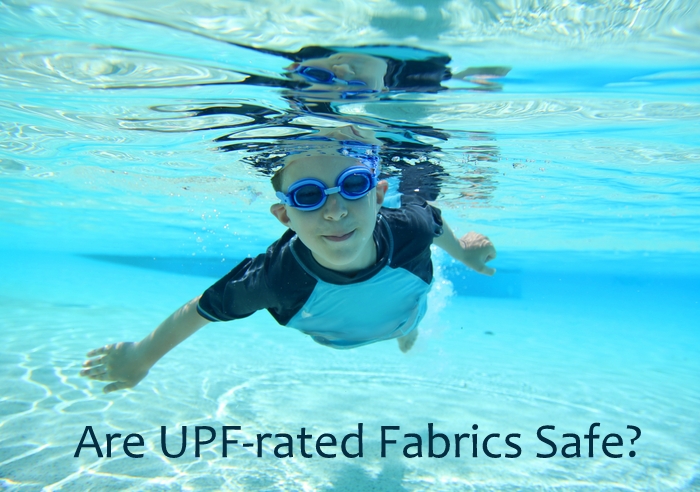
UV-Protective Swim Suits and Swim Shirts: Are They Safe?

© Depositphotos.com/micut


[Updated May 2016]

Whenever shopping for hats and other outdoor clothing products, I've always steered clear of products with a UPF (Ultraviolet Protection Factor) rating because I've been concerned that the UV-protection might be through the application of chemical sunscreens. Chemicals sunscreens such as oxybenzones are often endocrine disruptors and other undesirables.

This year, however, I needed to purchase a swim suit for my 4-year-old daughter. And it is difficult if not impossible to find a swim suit or swim shirt for children these days that does not advertise a UPF rating. In the past my kids have mostly worn hand-me-down swimsuits and swim shirts. I'm also willing to use second-hand swim shirts purchased at thrift stores. Although I vaguely understood that these hand-me-down and second-hand items most likely were UV-protective I didn't worry too much about it. Now, shopping for swim clothes online, I was confronted again and again with products advertising their UPF rating, so I decided to do some research into how clothing is made UV protective before making a purchase.


What Makes Fabrics UV Protective?


Is Your Garden Hose Leaching BPA, Lead, and Phthalates into Your Water?


With the weather heating up, our old seen-better-days plastic water table is getting renewed attention, particularly from my 18-month-old. I noticed several weeks ago when I would fill it up with water that I would smell this strong synthetic chemical smell coming from the table. I don't know what kind of plastic the water table is, but it has spent a lot of time in the sun, probably breaking down under the UV light, and I began to wonder if it was OK to let my kids continue to play with it.

CONNECT WITH ME


© 2008-2020 Eco-novice: Going Green Gradually All Rights Reserved

Copyright © Eco-novice | Powered by Blogger

Design by Anders Noren | Blogger Theme by NewBloggerThemes.com